

Brazil’s Vision for AI Diplomacy: Sovereignty, Scale, and Safety in a Multipolar World
How Brazil is balancing AI innovation, digital sovereignty, and global cooperation in a multipolar world
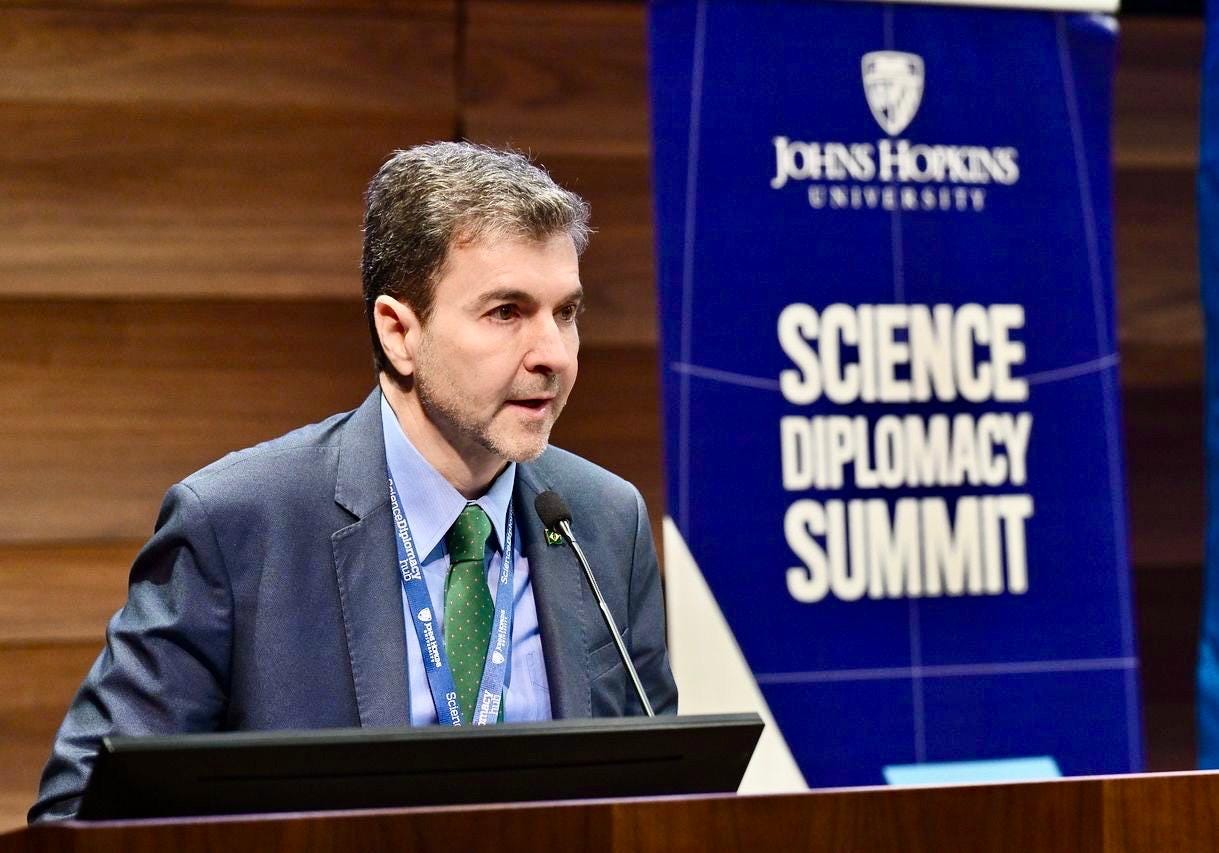
Photo: Eugenio Garcia
In Conversation with Ambassador Eugenio V. Garcia | Interview by Olin Thakur, Techplomacy Magazine
Editor’s Note
In an era where artificial intelligence is reshaping the global order, Brazil is positioning itself as a bridge between the Global South and the broader international AI governance debate. Ambassador Eugenio Garcia, who heads the Department of Science, Technology, Innovation, and Intellectual Property at Brazil’s Ministry of Foreign Affairs, has been navigating the intersection of diplomacy and technology, from Silicon Valley to the United Nations General Assembly. In this conversation, he reflects on Brazil’s vision for AI diplomacy: how to balance sovereignty with cooperation, promote equitable access, and avoid a new “Cold War mindset” in emerging technologies. His perspective offers policymakers and industry leaders an unvarnished view of AI governance in a multipolar world.
When Ambassador Eugenio Garcia talks about “digital sovereignty,” he doesn’t treat it as an obstacle to global cooperation but as its foundation. “Nations must have their own voice and be capable of determining clearly what their needs and priorities are,” he says. Without that voice, international standards risk becoming tools designed by others, locking countries into platforms or economic models that serve outside interests.
Garcia rejects the idea that sovereignty and binding international standards are in conflict. To him, they’re stages of the same process: self-determined priorities first, then cooperative standard-setting that respects them. This approach has shaped Brazil’s role in the BRICS Leaders’ Statement on AI governance, which he describes as “a collaborative governance of AI, not a competitive one.”
Ethical diversity is one of the thorniest challenges in AI policy. Concepts like fairness and transparency carry different meanings across cultures and legal systems, yet Garcia sees room for alignment. “The vocabulary for the global governance of AI is still under construction,” he notes. “Even without a single international definition, there is a certain consensus around principles.” The key, he says, is ensuring every country is heard, because “the opportunities arising from AI are not the same for all.”
For less-resourced nations, Garcia identifies three essentials for a thriving AI ecosystem: human talent, data, and compute infrastructure. Some countries have world-class researchers but lack the computing power; others have infrastructure but struggle to attract talent. Data is plentiful but often inaccessible or poorly structured. He argues for targeted capacity-building and cooperation to close these gaps, enabling countries to “use AI to further their development according to their own needs and capabilities.”
On AI governance models, Garcia is clear: the International Atomic Energy Agency (IAEA) is the wrong template. “Data is not like uranium or plutonium,” he says. AI, unlike nuclear material, is a general-purpose technology integral to economic development. Restrictive control would risk shutting out the very nations that stand to benefit most. Instead, he advocates for an inclusive, democratic framework that keeps AI “accessible without discrimination.”
When it comes to risk mitigation, Garcia is wary of framing AI through the lens of great-power rivalry. “One of the first risks we want to avoid is the entrenchment of a rigid ‘Cold War mindset’ around science and technology,” he warns. The BRICS approach, he says, emphasizes dialogue, representation for the Global South, and a focus on practical issues such as access to technologies, open standards, labor market impacts, and equitable access rather than solely hypothetical security threats.
The private sector’s dominance in AI innovation raises questions about co-regulation. Garcia insists the UN should be “at the core” of any global framework, but without necessarily creating a new AI-specific agency at this moment. Regulation, he says, remains mostly a responsibility of states, even in a multistakeholder setting. “Commercial incentives and the public interest may not converge in some cases,” he adds. “Good regulation can help find a balanced approach.”
In crisis scenarios, whether runaway misinformation or autonomous weapons without meaningful human control, Garcia points to prevention as the priority. “AI does not, by itself, create disinformation. It is a tool used by humans to do so,” he says. For hard security threats in matters related to international peace and security, the UN Security Council remains the proper venue. For promoting information integrity, digital education and media literacy are essential tools against bias, manipulation, and deepfakes.
At home, Brazil is advancing its own AI regulatory framework through a bill in the National Congress. The proposed law aims to strengthen legal certainty, clarify responsibilities, and encourage innovation by tailoring rules to different ecosystem actors. “Regulation and innovation are not mutually exclusive,” Garcia stresses. In his view, well-crafted rules can reduce risk, enable entrepreneurs to act, and allow innovation to flourish without undermining the public interest.
His philosophy comes back to balance: sovereignty and cooperation, innovation and safeguards, national needs and global norms. The BRICS Leaders’ statement on the Global Governance of Artificial Intelligence, he suggests, can serve as a blueprint for countries aiming to build AI ecosystems that value both public interest and innovation. In a rapidly changing technological landscape, Garcia sees AI governance not as a competition for dominance, but as an opportunity for nations, especially in the Global South, to help shape a system that works for all.
Ambassador Eugenio V. Garcia is a career diplomat with over three decades of service, has represented Brazil from Silicon Valley to the United Nations. He has served as Deputy Consul General in San Francisco, Head of Science, Technology, and Innovation, and focal point for Silicon Valley (2021-2024), as well as senior adviser to the President of the UN General Assembly (2018–2020). He is also an academic researcher on AI and global governance.
The views expressed in this article are those of the interviewee and do not necessarily reflect the views of Techplomacy Magazine or the Techplomacy Foundation. Articles may be republished in full, without alteration, with credit to Techplomacy Magazine (techplomacyfoundation.org).
Series: Techplomacy Conversations™
In Case You Missed It
BRICS Leaders' Statement on the Global Governance of Artificial Intelligence
Artificial Intelligence represents a milestone opportunity to boost development towards a more equitable future, fostering innovation, enhancing productivity, advancing sustainable practices, and concretely improving the lives of people everywhere on the planet.
To achieve that goal, global governance of AI should mitigate potential risks and address the needs of all countries, especially those of the Global South. It must operate under national regulatory frameworks and the UN Charter, respect sovereignty as well as be representative, development-oriented, accessible, inclusive, dynamic, responsive, grounded in personal data protection, the rights and interests of humanity, safety, transparency, sustainability, and conducive to overcoming the growing digital and data divides, within and between countries. Read More
IDAIS-Shanghai, 2025
At the International Dialogue on AI Safety (IDAIS) in Shanghai, leading researchers and policymakers issued a Consensus Statement on Ensuring Alignment and Human Control of Advanced AI Systems.
The statement warns that future AI systems may soon rival or surpass human intelligence, creating risks of unintended behavior and potential loss of control. Such scenarios could trigger catastrophic or even existential threats if powerful general-purpose AI operates outside human oversight.
Signatories—including Geoffrey Hinton, Yoshua Bengio, Stuart Russell, Andrew Yao, Ya-Qin Zhang, Gillian Hadfield, Max Tegmark, Dan Hendrycks, Seán Ó hÉigeartaigh and senior figures from various universities, and Anthropic—called for urgent international cooperation to ensure advanced AI remains controllable and aligned with human values.
The document frames this moment as a pivotal juncture for humanity, emphasizing that seizing AI’s opportunities requires confronting its risks through global coordination, technical safeguards, and governance mechanisms. Read More
White House Unveils America’s AI Action Plan
The White House has released Winning the AI Race: America’s AI Action Plan, following President Trump’s January executive order on removing barriers to U.S. leadership in artificial intelligence. The plan outlines more than 90 federal policy actions under three main pillars: accelerating innovation, building American AI infrastructure, and leading in international diplomacy and security.
Key measures include expanding AI exports through secure, full-stack packages for allies, speeding up permits for data centers and semiconductor plants, creating national initiatives to boost technical occupations, cutting federal regulations that slow AI development, and requiring government contracts with AI developers whose frontier models are free from ideological bias. Read More